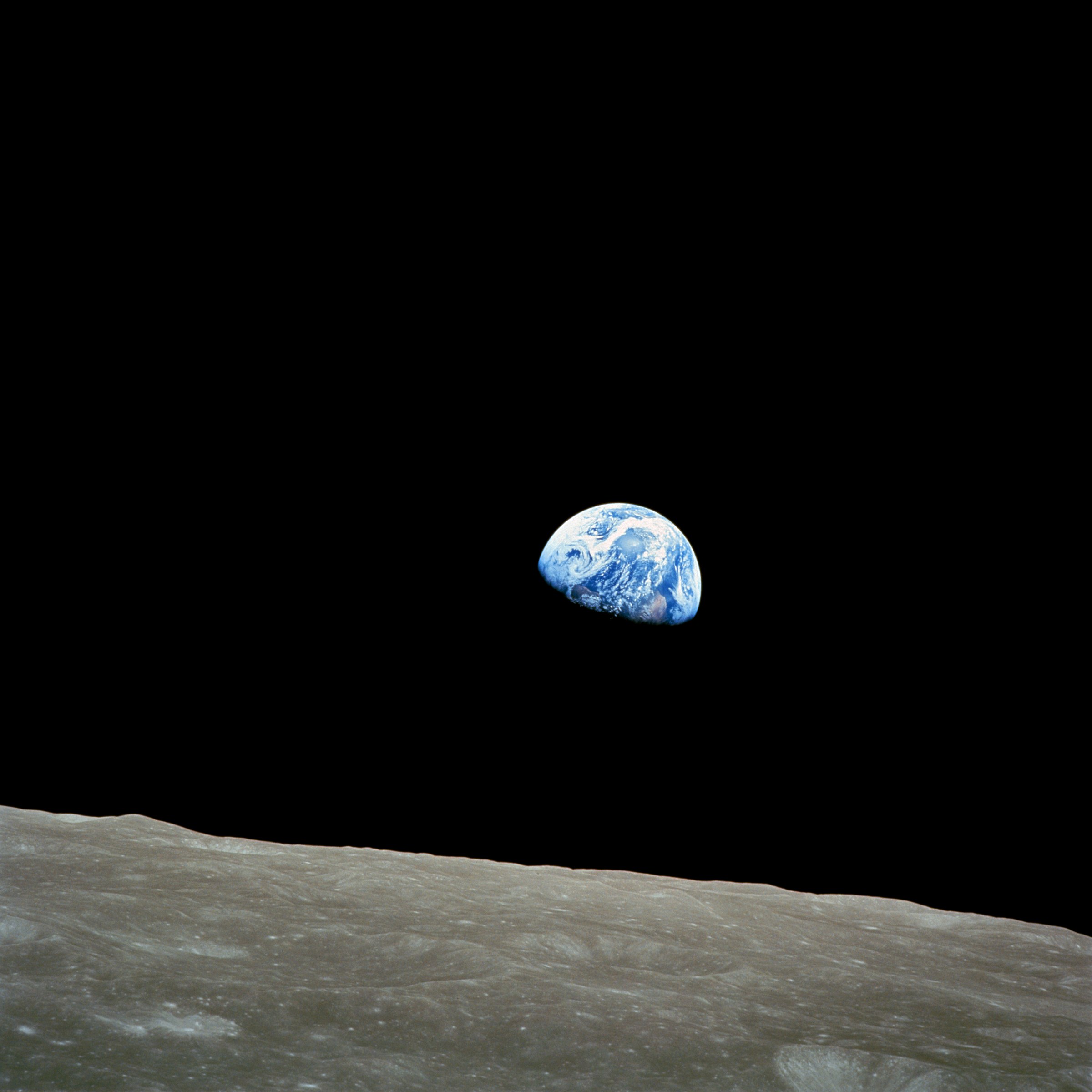
Since our species first emerged, the Moon has shaped human life. It lit our nights, timed our months, stirred our myths and tides. But on Christmas Eve, 1968, it did something new: it turned our gaze homeward.
Three astronauts aboard Apollo 8 became the first humans to orbit the Moon. They had trained for craters, rehearsed maneuvers. But it was a roll of the ship on its fourth orbit that brought an unexpected and electrifying sight. A swirl of blue and white, rising over the lunar surface, suspended in black.
Earth.
Fragile. Finite. Singular. Alive.
Bill Anders, scrambling for a camera, caught it. Earthrise. More than just a photograph, it became a mirror. Fifty years later, Anders observed: “We set out to explore the moon and instead discovered the Earth.”
NASA · Apollo 8 · December 24, 1968
From that vantage, borders vanish. Nations blur. You don’t see cities or war—just a lone, shimmering sphere cradled in darkness. Someone had been waiting for exactly this.
Counterculturalist Stewart Brand had spent two years distributing buttons with a pointed question: “Why haven’t we seen a photograph of the whole Earth yet?” A satellite had already answered him—its image of Earth from space adorned the cover of Brand’s first Whole Earth Catalog, published that same fall. But Earthrise was something altogether different: not a machine’s eye, but a human one, looking back from the Moon. It graced the Catalog’s next edition. The image that almost wasn’t taken—Anders had to beg for a color camera—would later be called the most influential environmental photograph ever made.
Earthrise cracked open a perspective no prior photograph had achieved. In circling the Moon, humanity saw itself for the first time. It took a barren satellite to teach us how singular and alive our planet is. Having seen Earth as a whole, we were no longer content just to look at the Moon. We wanted to stand on it.