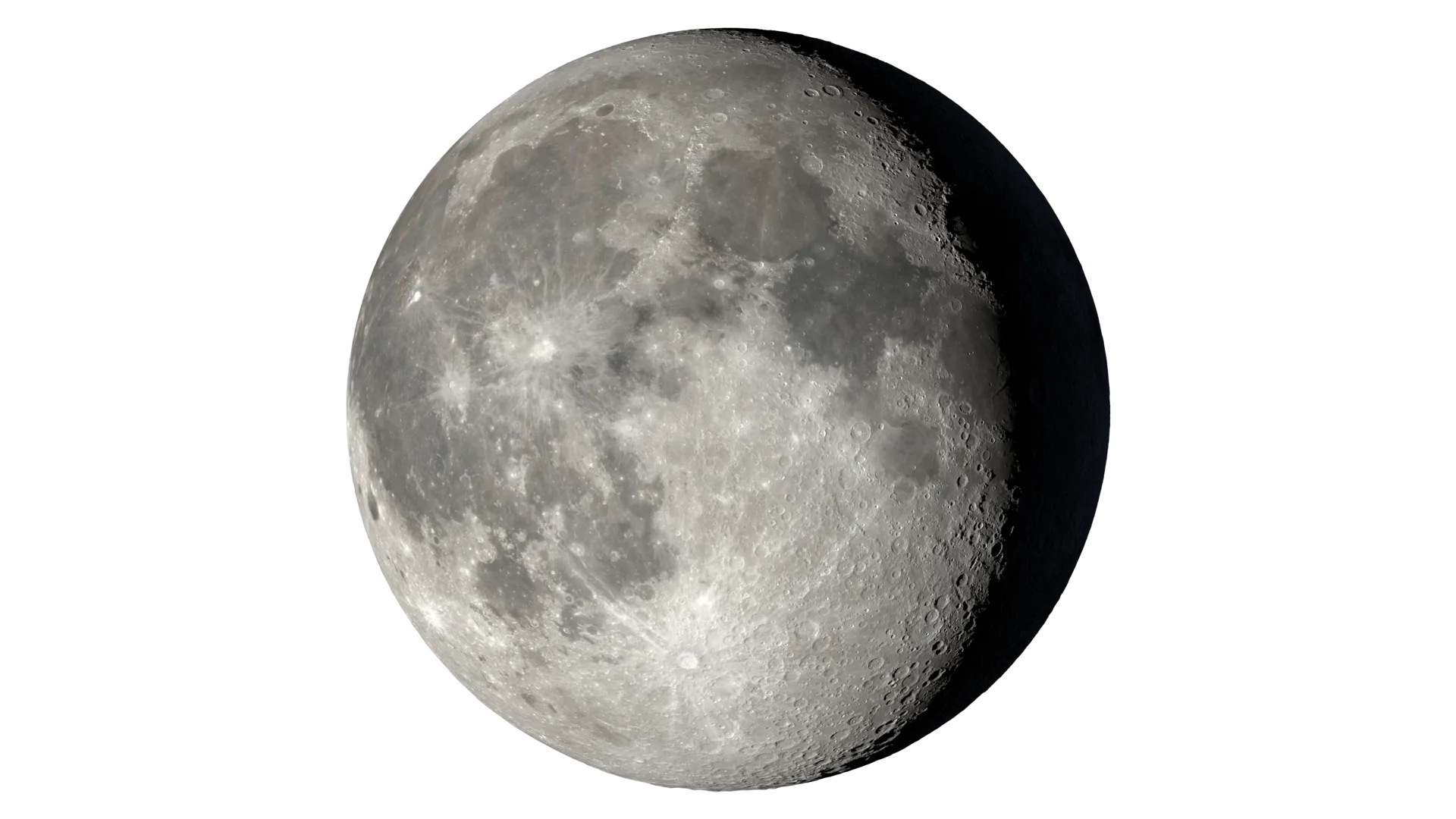
The Moon shows us only one face—an obvious fact so familiar it barely registers. The unseen half has gathered a reputation, slipping into myth as the “dark side,” as if being out of view meant being unlit. In fact, it receives exactly as much sunlight as the face we know. The explanation is both simple and strange: the Moon takes exactly as long to spin on its axis as it does to orbit Earth. That match is no coincidence. Over immense spans of time, Earth’s gravity slowed the Moon’s rotation, bleeding motion through internal friction until spin and orbit fell into lockstep. The result is tidal locking—the same gravitational force that drives our tides.
The lock isn’t perfectly rigid. The Moon wobbles slightly—a subtle sway called libration—letting us peek around the edges. Over time we can glimpse roughly 59 percent of the surface, but the far side remains, in every meaningful sense, a world apart. When the Soviet Luna 3 probe captured the first images in 1959, scientists were astonished: not a mirror of the near side but an alien wilderness of craters stacked on craters. The dark volcanic plains that dominate our familiar view—the maria—are nearly absent here. The crust runs roughly twice as thick, closer to 37 miles deep. What made the two hemispheres so different is now attributed to uneven heating during the Moon’s early history, which kept the near-side crust thinner and more volcanically active.
The far side’s most extraordinary feature isn’t visual—it’s invisible. Radio silence. The Moon’s bulk blocks all of Earth’s electromagnetic chatter: radio, television, every signal we generate. The result is the quietest radio environment in our immediate vicinity, silent enough to detect the universe’s earliest whispers—the faint low-frequency signals from the cosmic dark ages, the era before the first stars ignited.
Astronomers covet this quiet. NASA’s LuSEE-Night experiment, scheduled for delivery to the far side in 2026, is designed to test exactly this possibility. Larger arrays have been proposed, and scientists are already pushing for international protections on the radio-quiet zone before lunar activity makes it noisy. Earth grows louder every year. The far side of the Moon may be the last place close enough to reach—and quiet enough to actually listen.