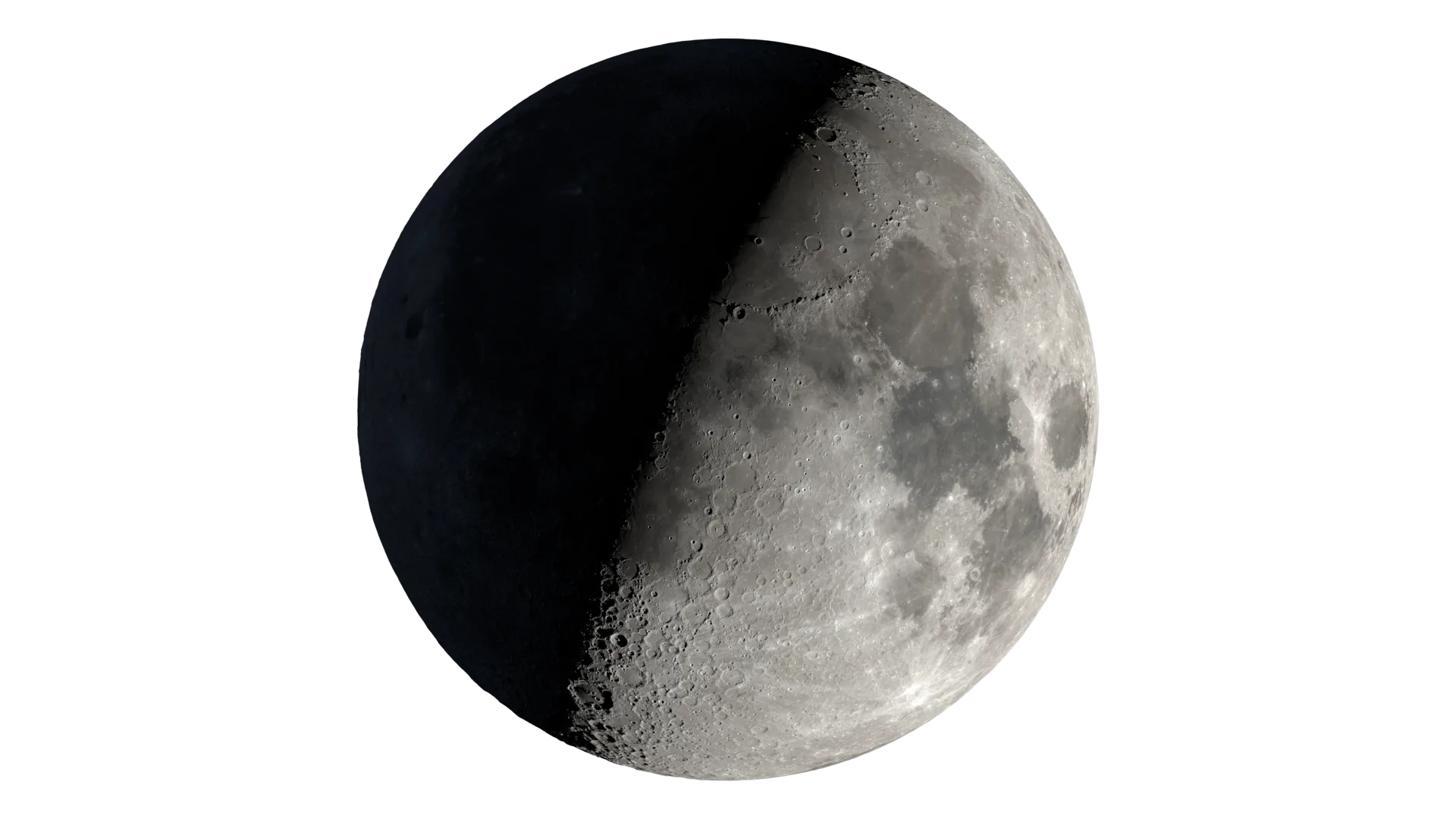
For much of human history, the Moon was thought to glow with its own mysterious fire—a living lamp in the night sky. The Sun and Moon were twin gods, each radiating their own power across the heavens. To suggest otherwise was nearly blasphemous: a downgrade from divinity to rock. But in the 5th century BCE, the Greek philosopher Parmenides made exactly that claim. The Moon doesn’t shine by itself. It reflects the light of the distant Sun. It sounds obvious now. For those of Parmenides’ time, it was a leap—in a world before glass mirrors, reflection itself was a mysterious concept.
Building on earlier ideas—perhaps those of Parmenides—Anaxagoras turned reflected light into a working model. If the Moon shines by sunlight, he argued, then its phases are simply geometry: a dark, rocky sphere, showing us more or less of its sunlit face as it swings around Earth. New moon, crescents, full moon—all just different positions of Sun, Earth, Moon. Eclipses followed from the same logic, stripped of omen: a lunar eclipse is Earth’s shadow falling across the Moon; a solar eclipse is the Moon’s body crossing the Sun.
These observations cracked the sacred divide between earth and heavens. For this, Anaxagoras was charged with impiety in Athens. To call the Sun a blazing rock and the Moon a reflector was to strip the gods of their fire. He was imprisoned and, by some accounts, only spared execution through the influence of his student Pericles. Forced to flee, he lived his remaining years in Ionia. Athens could exile the man, but not the idea.
Today, that idea seems obvious. Yet it marked one of the first steps away from myth and toward a universe that could be reasoned with. To recognize the Moon’s borrowed light is to begin seeing the world not as a stage for divine drama, but as a system, governed by knowable laws, discoverable by the curious mind.