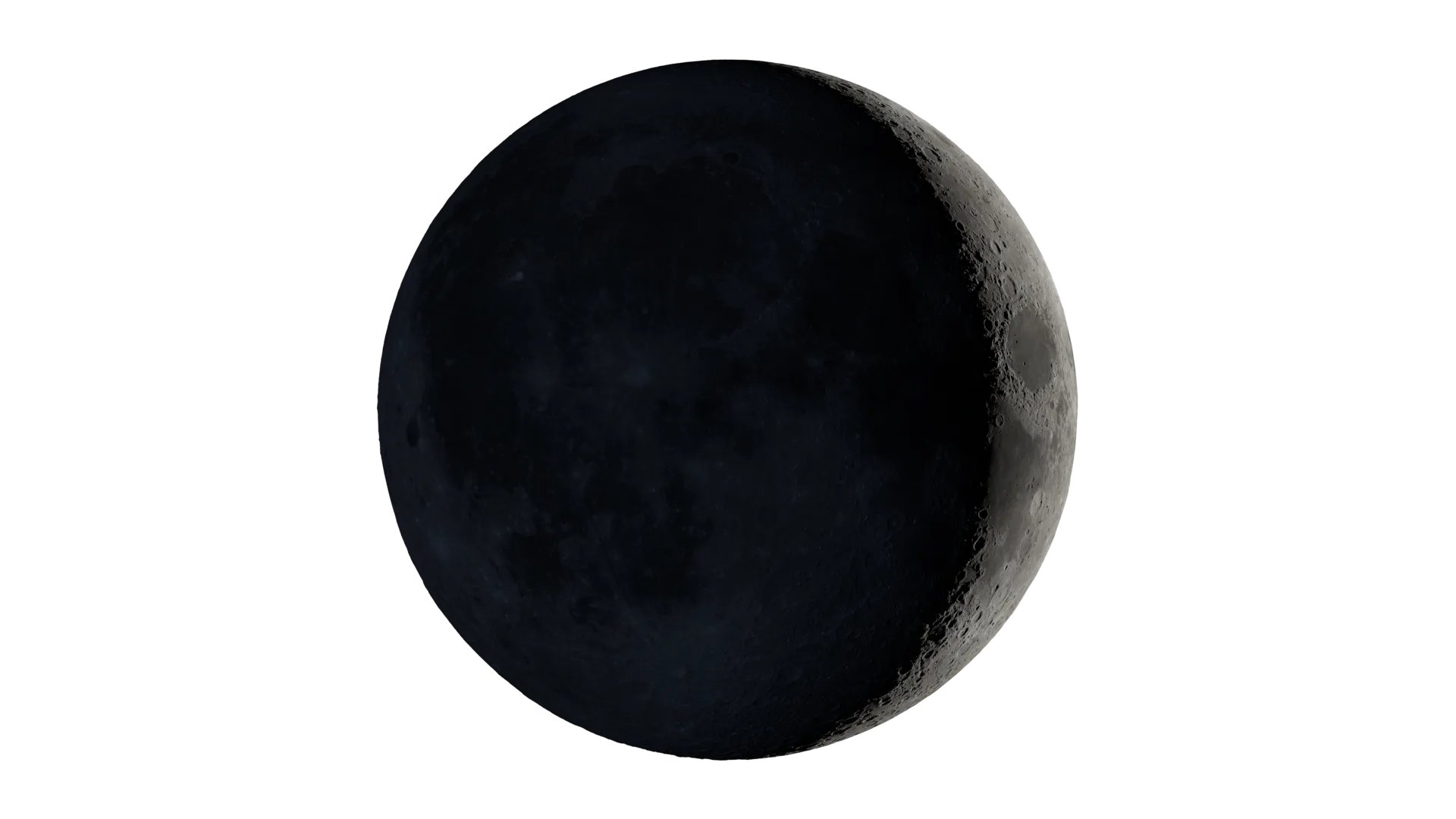
albedo—A body’s ability to reflect light, expressed as a ratio between 0 (perfectly absorbing) and 1 (perfectly reflective). Earth’s albedo fluctuates with cloud cover, ice, and ocean; those fluctuations are visible in earthshine.
axial precession—The slow, circular wobble of Earth’s rotational axis, completing one cycle every 26,000 years. Driven primarily by the Moon’s gravitational tug, it gradually shifts the positions of stars relative to our calendar—causing the North Star to change over millennia and the zodiac to drift out of alignment.
basalt—A dark volcanic rock formed from cooled lava. Much of the Moon’s maria consists of basalt laid down by ancient eruptions that flooded impact basins.
blue moon—Commonly, the second full Moon in a single calendar month. The phrase has older roots, but this modern definition is the one most widely used today.
circatidal clock—An internal biological timing system synchronized to the tidal cycle (roughly 12.4 hours) rather than the solar day. Found in many coastal organisms, these rhythms persist even in the absence of tidal cues, suggesting a deep evolutionary entrainment to the Moon’s pull.
corona—The Sun’s outer atmosphere, visible as a pale halo during a total solar eclipse. Its delicate streamers reveal hot plasma shaped by the Sun’s magnetic field.
earthshine—Sunlight that strikes Earth, reflects into space, and illuminates the Moon’s darkened face. Visible as a faint gray glow within the crescent’s horns, earthshine was first explained by Leonardo da Vinci. Its brightness tracks Earth’s reflectivity and is now used as a tool for monitoring planetary climate.
farside—The hemisphere of the Moon usually hidden from Earth. It is not permanently dark, but it is far more heavily cratered and has fewer maria than the nearside.
highlands—The Moon’s older, brighter, heavily cratered terrain. The highlands dominate much of the farside and are compositionally distinct from the darker maria.
kalendaria—Roman account books in which debts and financial obligations were recorded. Named for the Kalends—the first day of the month, announced when the new crescent Moon appeared—these ledgers embedded the lunar calendar into commerce and law.
Late Heavy Bombardment—A hypothesized period roughly 4 billion years ago when the inner solar system, including the Moon, was pelted by an intense surge of asteroids and comets. The evidence is written across the Moon’s surface in its oldest, most heavily cratered terrain.
libration—The Moon’s subtle wobble as it orbits Earth, a product of its slightly elliptical orbit and tilted axis. Over time, libration allows us to glimpse roughly 59 percent of the lunar surface, despite the Moon being tidally locked.
lunation—A complete cycle of the Moon’s phases, from one new Moon to the next. Averaging 29.53 days, a lunation is also called a synodic month. The exact length varies because both the Moon’s orbit and Earth’s orbit are elliptical, not perfectly circular.
lunisolar calendar—A calendar system that tracks months by the Moon while adding periodic adjustments to stay aligned with the solar year. Hebrew and traditional Chinese calendars are examples.
maria (sing. mare)—The dark, flat plains that dominate the Moon’s near side. Formed by ancient volcanic eruptions that flooded low-lying basins with basalt, the maria were long mistaken for seas. Their Latin name—meaning “seas”—persists in names like Mare Tranquillitatis (Sea of Tranquility).
magma ocean—A global or near-global layer of molten rock thought to have existed on the early Moon after its formation. As it cooled, lighter minerals rose and helped form the lunar crust.
Metonic cycle—A 19-year period after which the phases of the Moon recur on nearly the same dates of the solar year. Many lunisolar calendars use it to reconcile lunar months with the seasons.
nearside—The hemisphere of the Moon that faces Earth because of tidal locking. It contains most of the large maria visible from Earth’s surface.
noctuary—A journal or record of things observed, thought, or dreamed at night. Less common than “diary,” a noctuary emphasizes nocturnal reflection, imagination, and memory.
radio-quiet zone—A region shielded from human-made radio interference. The Moon’s farside is prized as a potential radio-quiet zone for listening to faint signals from the early universe.
regolith—The loose, fragmented layer of rock and dust covering the Moon’s surface. Created by billions of years of meteorite impacts and extreme temperature swings, lunar regolith is glassy, electrostatically charged, and extraordinarily abrasive—a persistent challenge for equipment and astronauts alike.
Saros cycle—An 18-year, 11-day pattern after which the Sun, Earth, and Moon return to nearly the same alignment, causing eclipses to repeat in a predictable sequence. Recognized by Babylonian astronomers, the Saros cycle was one of humanity’s first tools for forecasting celestial events.
sidereal month—The time it takes the Moon to complete one orbit relative to the background stars, about 27.3 days. It is shorter than a synodic month because Earth is also moving around the Sun.
syzygy—The alignment of three celestial bodies in a straight line. In the Earth-Moon-Sun system, syzygy occurs at new Moon (Sun-Moon-Earth) and full Moon (Sun-Earth-Moon), producing the conditions for eclipses and the strongest tidal forces.
synodic month—The time it takes the Moon to return to the same phase as seen from Earth, averaging about 29.53 days. This is the cycle most people mean when they refer to a lunar month.
Theia—The hypothesized Mars-sized protoplanet that collided with the early Earth about 4.5 billion years ago. In the leading model of lunar formation, debris from that impact coalesced into the Moon.
tidal locking—The state in which a moon’s rotational period matches its orbital period exactly, causing it to keep one face permanently toward its planet. Earth’s gravity gradually slowed the Moon’s spin over billions of years until lockstep was achieved. Most large moons in the solar system are tidally locked to their planets.
umbra—The darkest central part of a shadow, where the light source is completely blocked. During a total lunar eclipse, the Moon passes through Earth’s umbra.
yareach—An ancient Semitic word meaning “Moon,” used across the ancient Levant. The name of Jericho—one of the world’s oldest continuously inhabited cities—is often linked to this root, suggesting the city’s identity was bound up with lunar timekeeping from its earliest days.